A Landscape Assessment of State Policy Responses to Energy Load Growth
For my capstone research at the Yale School of the Environment, I assessed emerging state and federal policy responses to electricity load growth.
- Field
- Energy Policy
- Institution
- Yale School of the Environment
- Year
- 2025
- Type
- Capstone research
The challenge
The U.S. electricity system is facing a new wave of demand growth, driven by data centers and artificial intelligence, advanced manufacturing, and widespread electrification. Meeting this demand requires new infrastructure, but it also raises difficult questions about who pays for grid expansion, how utilities manage uncertainty, and how governments balance reliability, affordability, and energy development.
The research
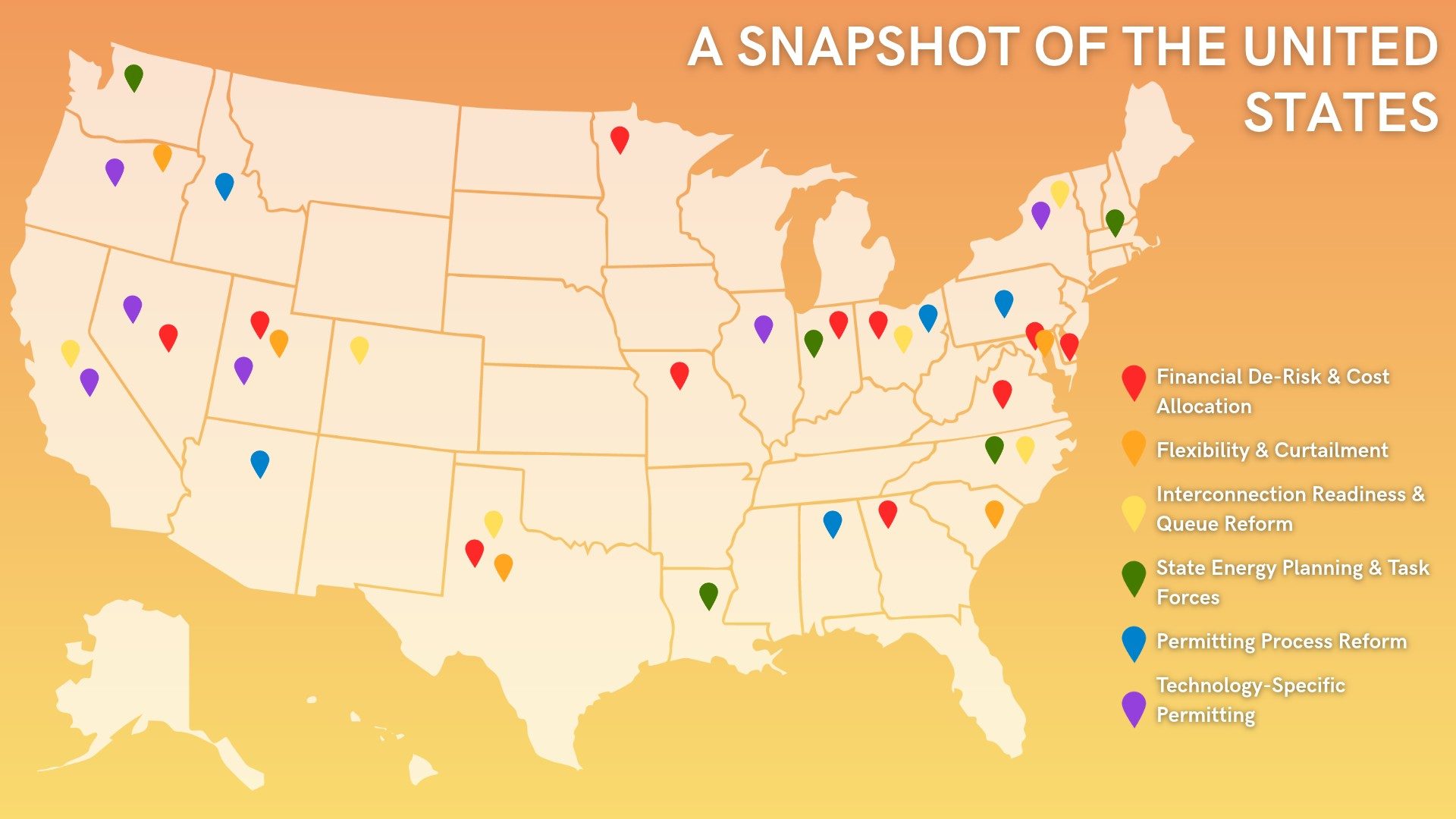
For my capstone research at the Yale School of the Environment, I assessed emerging state and federal policy responses to electricity load growth. I reviewed legislative, regulatory, and planning initiatives across the country, organizing them into a framework spanning cost allocation, grid flexibility, interconnection reform, state energy planning, and permitting.
The assessment examined how different jurisdictions are approaching a shared challenge, from requiring large electricity customers to shoulder more of the costs associated with their demand to streamlining infrastructure development and incorporating large loads into long-term grid planning.
Key themes
-
Who pays for new infrastructure?
States are developing new tariffs, contracts, and cost-allocation mechanisms to assign more of the financial risk of grid expansion to the large customers driving demand growth.
-
How can the grid accommodate new demand?
Policies increasingly address operational flexibility, demand curtailment, and interconnection readiness to improve reliability and reduce delays in bringing new capacity online.
-
How are governments changing the rules?
State and federal approaches to permitting and energy planning reflect different priorities for accelerating infrastructure development, coordinating agencies, and shaping the future energy mix.
Why it matters
The policy decisions being made today will shape how the U.S. power system responds to growing electricity demand. Understanding these emerging approaches is essential to evaluating how new infrastructure gets built, how its costs are distributed, and how governments navigate competing priorities around reliability, affordability, and energy development.